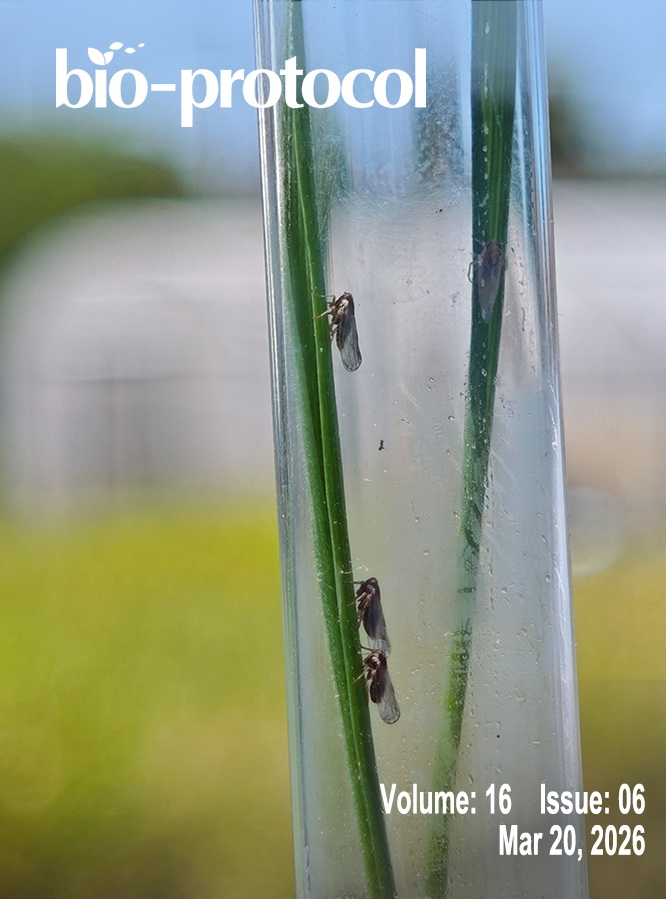
Controlled Transmission of a Fijivirus Under Field Conditions Using Mass-Reared Planthoppers
Autor: Dumon, Analia Delina; Barcenilla, Milene Rocio; Bariles, Julieta B.; Pereyra, Nicolás; *** Rodriguez, Sandra Monica***; Mattio, Maria Fernanda
Mal de Río Cuarto disease, caused by a Fijivirus, is a major constraint for maize production in Argentina.
The traditional evaluation of resistant hybrids is limited by the low efficiency of natural virus transmission and the lack of standardized field inoculation methods. We developed a protocol that combines laboratory mass-rearing of the planthopper vector Delphacodes kuscheli with a controlled field transmission system. The method involves the synchronized production of large insect populations, acquisition of viruliferous vectors under controlled conditions, and their safe transport to the field using specialized containers. Transmission is achieved through individual cages placed on maize seedlings, ensuring high inoculation pressure under field-like conditions. This protocol enables reliable and reproducible virus transmission, facilitating large-scale screening of maize hybrids and other cereals. Its main advantages are the high throughput of vector production, improved transmission efficiency, and adaptability to diverse experimental designs.
Para ver el contenido completo, ingrese al repositorio institucional ONTA Digital